
Skip to content
ELT Vista

ELT Vista

Personal and Professional Development for TESOL Teachers

  • About Us
    • Newsletter
    • Privacy Policy
  • Contact Us
  • Courses
    • ELT Vista Certificate in Humanistic TESOL Teaching
    • Courses Overview
  • Publications
    • What About The Teacher?
  • Services
  • Articles for TESOL Teachers
  • Toggle search form

Tag: ELT Vista

The CEFR, Can Do Statements, and the Confusion Around Learning Outcomes

Posted on May 16, 2026May 16, 2026 By Jay Leonard Schwartz
The CEFR, Can Do Statements, and the Confusion Around Learning Outcomes

Part 1 of a short ELT Vista series exploring learning outcomes, CEFR descriptors, operationalization, accreditation culture, and the growing tension between standardized educational systems and the human realities of language learning.

The Historical Confusion

CEFR LO CANDO AUTHORITY

It was recently suggested to me that all learning outcomes came from the CEFR Can Do statements.

Historically, this is inaccurate. However, pedagogically, the misunderstanding also reveals something much larger about modern language education and how easily different ideas become collapsed into a single narrative. If this were merely a matter of correcting revisionist history, the issue would be relatively minor. My concern, however, extends to how this false narrative affects real students, real teachers, and real classrooms—in other words, the human arena itself.

Learning outcomes did not suddenly appear with the Common European Framework of Reference for Languages (CEFR). Educational systems had already been working with objectives, competencies, performance criteria, behavioral outcomes, and various forms of outcome-based education for decades before the CEFR was formally published in 2001. Figures such as Benjamin Bloom, Ralph Tyler, and Robert Mager had already contributed significantly to broader educational theories surrounding objectives and measurable performance long before the CEFR emerged from the work of the Council of Europe.

The CEFR descriptors themselves were heavily informed by communicative-functional approaches and descriptor research during the 1990s, particularly through the work of Brian North and related European language assessment projects. In other words, the Can Do descriptors were not the origin of learning outcomes themselves. Rather, they were part of a much larger educational and assessment tradition already developing internationally.

However, over time, these distinctions became blurred. Publishers, examinations, institutions, curriculum systems, accreditation structures, and commercial educational ecosystems increasingly operationalized Can Do language so successfully that many teachers understandably began associating learning outcomes almost exclusively with CEFR-style descriptors.

Read More “The CEFR, Can Do Statements, and the Confusion Around Learning Outcomes” »

Blog

Earth Day: When the Ocean Speaks Back

Posted on April 21, 2026April 21, 2026 By Jay Leonard Schwartz
Earth Day: When the Ocean Speaks Back

Earth Day, the Anthropocene, and the Language Classroom:
Bringing Environmental Responsibility into the Conversation

ELTIVSTA.COM, EARTH DAY, TESOL

Each year Earth Day encourages reflection on the condition of the planet we share—and what we have done to it. In recent decades, scientists and historians have increasingly used the term Anthropocene to describe our present moment, a proposed geological era in which human activity has become a dominant force shaping the Earth’s climate, oceans, and ecosystems more so for the worse.

The idea is unsettling.

For most of human history, nature molded civilization. Yet today, civilization increasingly deforms nature. Forests disappear in decades rather than in centuries. Glaciers that took thousands of years to form are melting within a generation. Oceans that once seemed vast enough to absorb anything are now showing unmistakable signs of stress, as well as our refuse.

Read More “Earth Day: When the Ocean Speaks Back” »

Blog

All Dogs Must Wear Pants: When the Ridiculous Becomes Communicative

Posted on April 3, 2026April 4, 2026 By Jay Leonard Schwartz
All Dogs Must Wear Pants: When the Ridiculous Becomes Communicative
An Absurd Suggestion from the Constituents
CLT, SEL, ELT Vista, eltvista.com

Imagine presenting the following situation to a class.

A newly formed political party has invited suggestions from its local constituents about laws that might improve the community. Party members must review the proposals and decide which ones should become official policy. Among the suggestions submitted is the following:

All dogs must wear pants in public.

Students are members of the political party. Their task is to discuss the proposal and decide whether the party should officially propose the law.

To reach a decision, they might discuss questions such as:

  • Why would someone propose this law?
  • Who might benefit from it?
  • What problems could it create?
  • Would it apply to all animals?

The premise is obviously ridiculous. Yet the interaction that follows often becomes surprisingly lively. Students debate practicality, fairness, ethics, modesty, enforcement, and even fashion. They interrupt one another with alternative ideas. They defend positions and challenge arguments. They comment on how ludicrous the whole thing is because animals are not people, etc.

The scenario is absurd. The communication, however, is real.

Read More “All Dogs Must Wear Pants: When the Ridiculous Becomes Communicative” »

Blog

Grades, Judgment, and the Machinery of Worth

Posted on January 4, 2026January 4, 2026 By Jay Leonard Schwartz
Grades, Judgment, and the Machinery of Worth

Grades, Judgment, and the Machinery of Worth

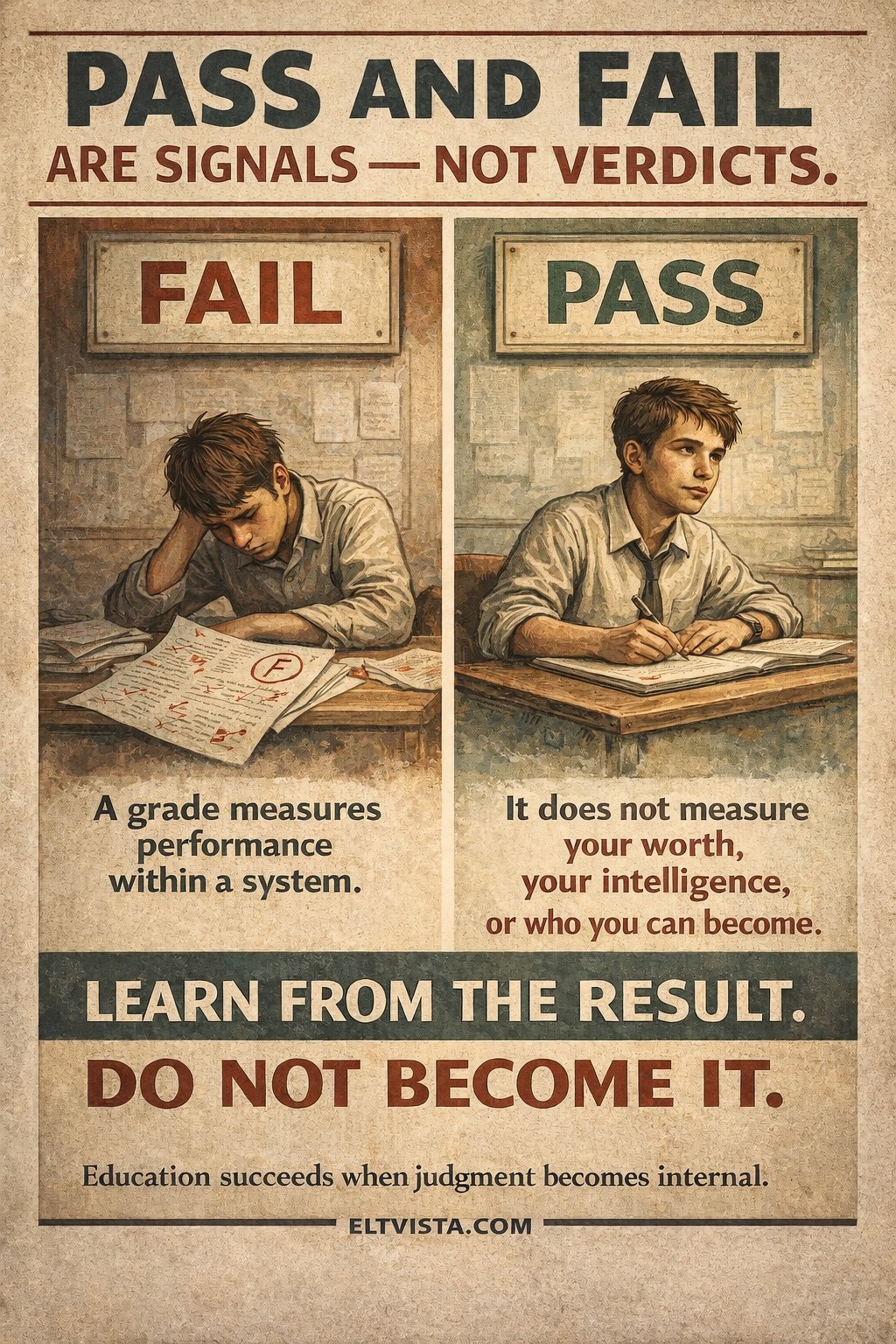
Grades are Signals

Nobody ever tells students the most dangerous thing about grades:
they don’t just measure performance—they train you to outsource your sense of worth.
They feel neutral and necessary. That’s exactly why they’re dangerous.

Grading is a necessary evil in education. Necessary, because institutions require some way to sort, credential, and move people through systems at scale. Evil—not in a melodramatic sense, but in a quiet, corrosive one—because grades are so easily mistaken for something they are not.

A grade is information. It is a signal within a bounded system. It is not a measure of human worth, potential, or legitimacy. Most students are never explicitly told this, which is why the signal so easily becomes a verdict. Unless that caveat is made explicit, students absorb something far more dangerous than the grade itself: the idea that judgment arrives from elsewhere, and that its verdict is final.

This is where the real injustice begins. Not because the system is intentionally cruel, but because it is largely silent about what its judgments are meant to mean—and what they are not.

Read More “Grades, Judgment, and the Machinery of Worth” »

Blog

Of Resolutions, Humbug, and Community—A Reflective Riff on Scrooge

Posted on December 18, 2025January 4, 2026 By Jay Leonard Schwartz
Of Resolutions, Humbug, and Community—A Reflective Riff on Scrooge

Long before resolutions became annual rituals, Charles Dickens, the nineteenth-century English novelist and social critic, offered a rather effective alternative. In A Christmas Carol, Scrooge does not sit down and draft a list of behavioural targets or learning outcomes. He is shown his life—where it came from, how it currently unfolds, and where it is heading if nothing changes.

Blog

Copyright ©2024 ELT Vista, Jay Leonard Schwartz.

Powered by PressBook Green WordPress theme